Meet Chiara Vercesi
Get to know our amazing roster of artists
Hi! Welcome to the Roar "Meet the Artist Series" thank you so much for taking the time to sit with me and chat about all things art, career, business, and you! So, with that in mind, would you like to tell us a little bit about yourself?
Hi, I’m Chiara! I’m from Milan (IT), but I have been living in Amsterdam (NL) for the past 14 years.
Roar: When did you know you wanted to be an artist?
I was 8 years old. I loved drawing, and for a series of circumstances, I ended up studying traditional painting techniques with a bunch of pensioners at an elderly center for a couple of years (8 to 10). The teachers were two retired professors from Brera Art Academy in Milan. It was love at first sight. I knew immediately I wanted to do that for a living. Figuring out how to do that took so much longer!
Roar: Tell us about the journey to get to where you are today?
I studied at Liceo artistico (art school) first, then Illustration at IED Milan, followed by some courses and workshops, the last one at Visual Arts Passage. I still enjoy studying something new or learning from someone I admire whenever I can. I have been roaming the creative world in different capacities for the past 20 years. I started as an illustrator for games and board games, which taught me a ton about real-world production constraints, packaging, and thinking in terms of final print rather than just digital files. Then I moved to the Netherlands and began working on advertising commissions, mainly illustrating for animated videos. After a couple of years, I joined a digital agency, first as a designer, then as an art director. During that time, I worked extensively with Philips Healthcare, which ended up being key to what I do today.
A lot of people influenced my career. A career does not happen in a vacuum, and the self-made-whatever is just the adult version of Santa. A career is a result of your efforts for sure, but also opportunities and people you find along the way that are influential to you at different moments in time. For me, it started with my grandma. She was the one who took me to the elderly centre where I had my first painting lessons, and she always encouraged me to pursue illustration. Then, after university, there was Spartaco Albertarelli, game designer. He gave me my first professional assignments, and we worked together for the first six years of my career. We haven’t collaborated in a while, but I’ll always be grateful for everything he taught me about the job when I was just starting out.
Roar: Love this!!
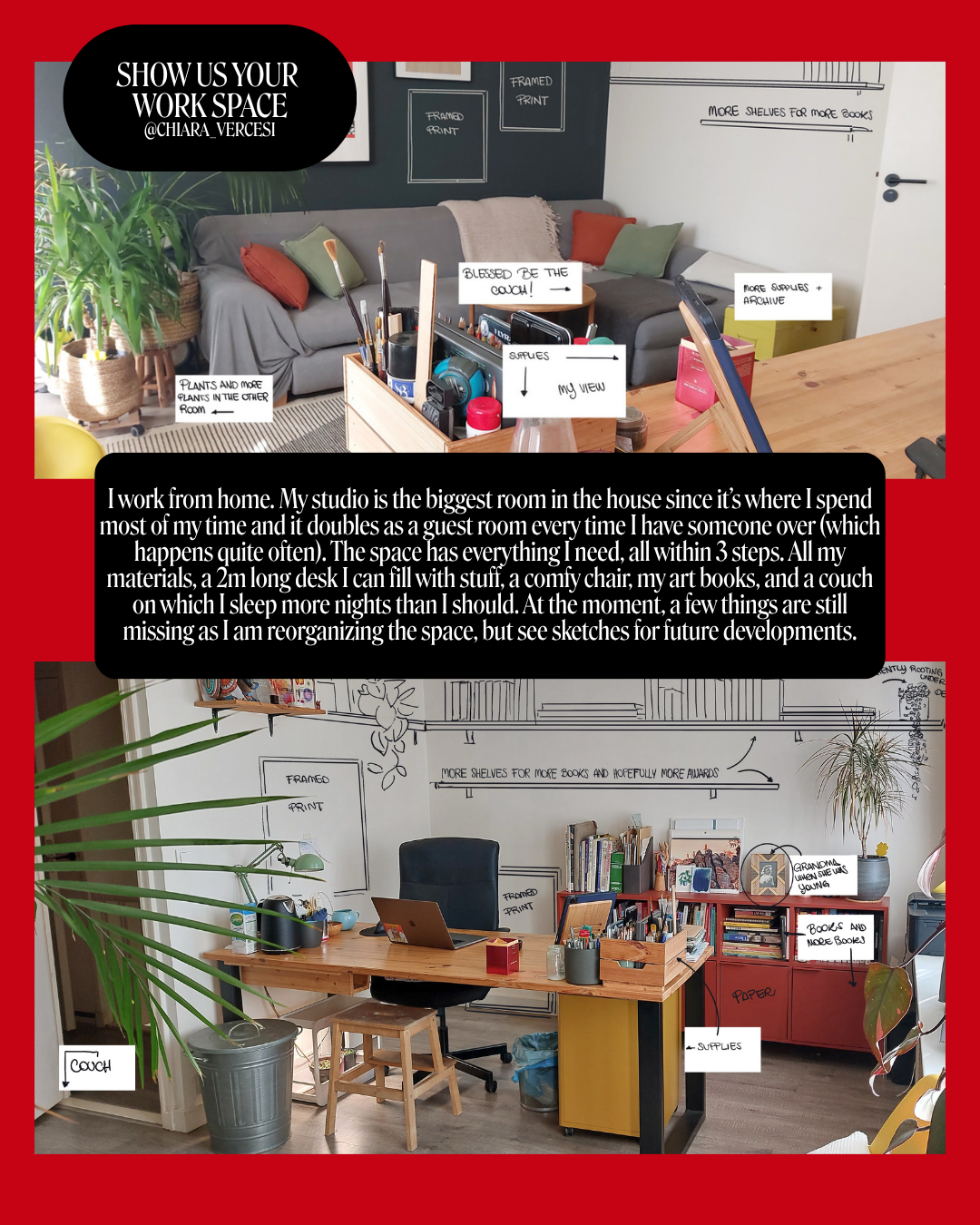
Roar: Show us your working space! Do you have a studio, or do you WFH?
I work from home. My studio is the biggest room in the house since it’s where I spend most of my time and it doubles as a guest room every time I have someone over (which happens quite often). The space has everything I need, all within 3 steps. All my materials, a 2m long desk I can fill with stuff, a comfy chair, my art books, and a couch on which I sleep more nights than I should. At the moment, a few things are still missing as I am reorganizing the space, but see sketches for future developments.
Roar: Tell us a little more about how you work
My process: I’ve actually created a diagram for this (pure coincidence! I made it for a presentation, I don’t usually carry diagrams around). In practice, it translates into writing > scribbling > sketching (digital or traditional) > eventually something that makes sense. I have a sequence from brief to final, from a piece I did last year for National Geographic. It’s easier if I show you.
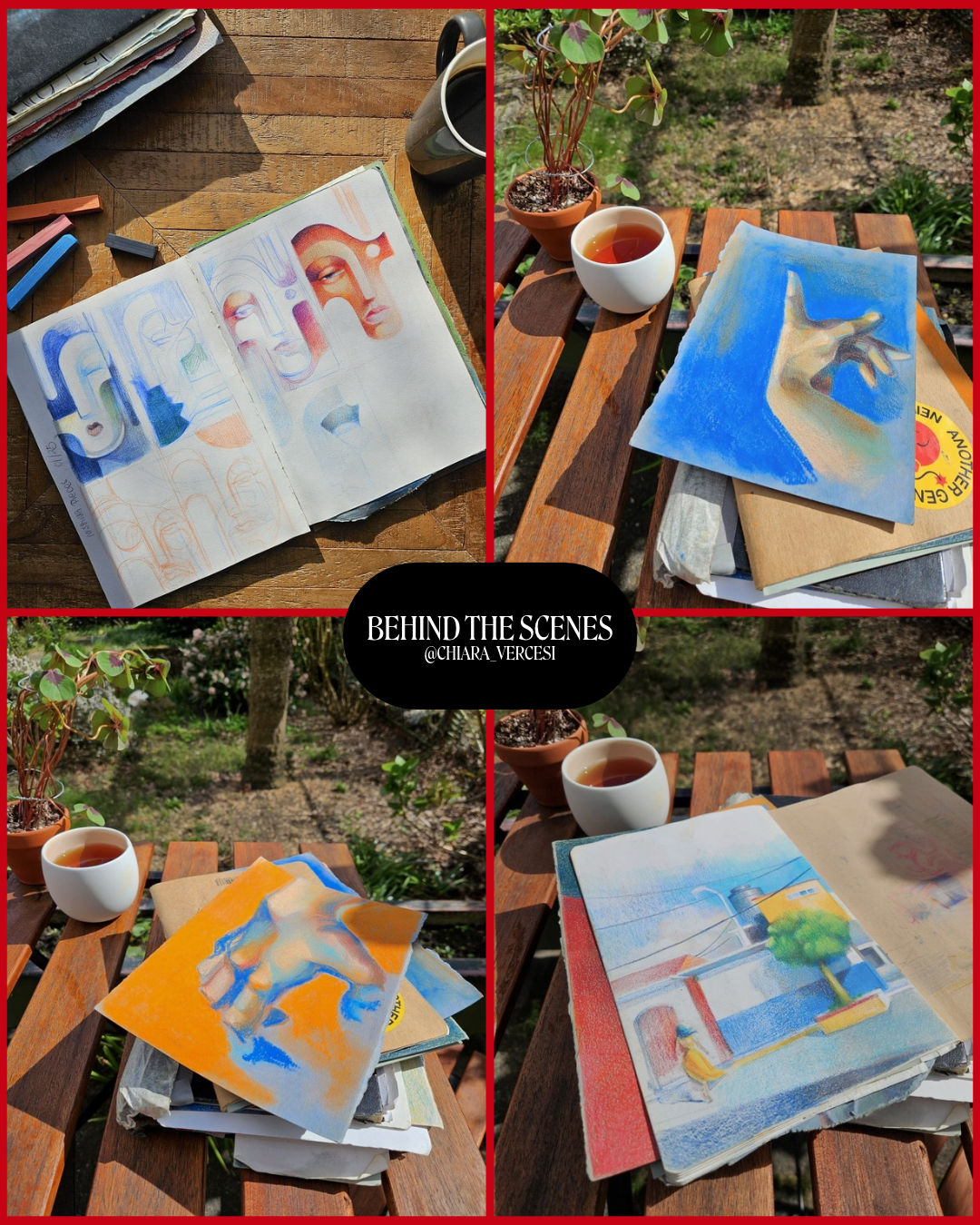
Materials: For sketching, I use pretty much anything: pencils, pens, chalk and Procreate. (Photo courtesy of my friend Merve). For final work, it depends on the project: Procreate, Photoshop, and Illustrator, but more recently, I’ve gone back to coloured pencils and soft pastels and mix them with some digital finishes.
Learning curve; Still curving: Things keep changing, and there’s always something new to figure out. Some parts of the process have become natural over time; others I’m still learning because I simply haven’t had to deal with them before. Getting from a good personal portfolio piece to a client-ready one isn’t the hardest step, but everything around it is ongoing work.Some steps feel steep, others flatter, but for me, it never really leveled out.
Roar: If you use any tools, programmes (think wacom, tablets etc) tell us a little bit about that, how it works, how they help you work, and just a little about the process etc.
Like everybody, I have my favourite tools I use consistently, but I am not a massive fan of tools. I am a firm believer that you should be able to produce a decent image regardless of the tools you have available, because I do not think that mastering a tool equates to mastering the craft. Having said so, I find the iPad to be an incredibly useful tool, especially when traveling or working on the move. I still sketch a lot traditionally with everything I can put my hands on.
Roar: How do you prepare for your working day?
I don’t! Routines terrify me deeply, so I’ve made a point of not having any. I eat when I’m hungry and sleep when I’m tired.
Every day looks different depending on what I need to get done. On Sundays, I usually write down everything for the week ahead and make sure it’s done by the next Sunday, meeting deadlines and leaving room for unexpected projects or hiccups. Over time, I’ve learned that forcing myself to work through energy dips is counterproductive, while following the peaks leads to much better performance and results. That might mean working late on a Saturday night and then crashing on a Monday afternoon after delivering a project. I know it sounds chaotic, but it really isn’t once you let go of the expectation that we all need to follow the same routines to be healthy and happy.
Roar: We love this mindset, we’re going to work this into our own lives!
Roar: Do you have pets?
I used to, but my dogs and my ferrets passed away a while ago. Now, as an aunty, I occasionally cat-sit the two roundest and cutest cats in the Netherlands (affectionately called the Tondis or Round and Rounder) and dog-sit royalty (a Corgy named King Gatsby) when my friends.
Roar: Least favourite subject matter to draw?
Feet
Roar: Favourite subject matter to draw?
Hands, animals, architecture, pills, viruses. In terms of broader topics, give me all things nature, and I’ll be happy.
Roar:How has AI impacted your career (if at all) and have you changed your approach to the way you work because of it?
It’s difficult to quantify. Last year, like many other creatives, I had a dip in commissions. This year, things seem to be picking up. Was it AI, general economic uncertainty, or companies freezing budgets? A mix of everything? Not sure.
Has it impacted my way of working? Yes. I am running in the opposite direction.
When the output is apparently achievable by everyone (it’s not, but for argument's sake, let’s say it is), the process becomes more valuable. I think, well, I hope, that there are still people interested in human-made work, with all its imperfections and contradictions. For them, the how and why start to matter as much as the what, as a kind of proof of humanity.Sorry, I did not mean to go all philosophical on you, but I’ll stand by it.
Practically, it means I’m slowly returning to analog materials, focusing more on personal (and less strictly commercial) work, and documenting the process more intentionally.For now, a few things coexist, but I am in a transition period, so come back next year for updates.
Roar: What would you want to say to anyone who thinks that AI is a harmless tool esp. if they are a commercial "artist"?
Roar: What would you want to say to anyone who thinks that AI is a harmless tool esp. if they are a commercial "artist"?
Atone for your sins, or may you have wet socks from here to eternity, and may your pants always be 2 inches too short.Voodoo curses aside, it’s been proven time and again that this tool, as it currently exists, is far from harmless.
In design, it serves as an unnecessary shortcut in the name of efficiency, at the expense of intellectual property, craft, and the livelihoods of countless artists. Their work has been used without consent or compensation, while companies profit from models trained on that very material, effectively cutting them out of the process. Zoom out, and the implications become way more troublesome. AI is already contributing to environmental strain, job displacement (and I am not only talking about creatives), and amplifying misinformation and propaganda. So, we were saying… Harmless? I could go on for hours, but people far smarter and more qualified than I am have already written plenty of research on the topic, and I am not trying to bore you into submission.
As a creative, I enjoy my work. I chose it. And so far, I have failed to meet another illustrator who didn’t. Literally, nobody I have ever met was looking to make illustration “more efficient”. And if you don’t enjoy it and are just looking for a salary, my friend, there are so many easier ways to get one! No need to be an artist if you don’t want to be one.
Roar: HERE HERE!! LOUD CLAPPING AND WHOOPING FROM US!!!!!
Roar: Who is an art director that you appreciate?
There are many, and I’ve been lucky to work with some great people over the years. So a general shoutout to all, and a couple of special mentions:
Michael Mrak: He gave me my first commission for Scientific American. Many more followed, and some of my favourite projects (including a WIA award winner) came out of that collaboration. A great creative director, and an even better person.
Melissa Miller: A joy to work with. We’ve collaborated several times, and she often gives me free rein with the illustrations, then builds the page layout around them. How cool is that?
Roar: How did you handle your worst client experience?
With grace and receipts.
Roar: What other artistic mediums motivate you?
Music — the last concert I went to was Electric Callboy.
Literature — I am currently reading Stella Maris by McCarthy.
Photography — I adore photo exhibits and photo reportage, even though, for the life of me, it’s a medium I can’t use. The last exhibition I saw was Ed van der Elsken, featuring incredible images of Amsterdam from the ’60s to the ’80s, and next week I’m going to the World Press Photo. I hate taking pictures just as much as I enjoy looking at them.
Roar: Who is your dream client to work for?
I have already worked for a few of those :) A dream client is someone who involves me in the project. Collaborations are more exciting than assignments. If we are talking names, are we referring to people I haven’t worked with yet? Only one? I have an entire list! Here some names Organisations I respect: Emergency, Doctors Without Borders Books I’d like to see my name somewhere on, one day: Folio Society Bands I’d love to illustrate for: The Cure Magazines I read and would love to contribute to: Internazionale So, dear Santa, if you are listening…
Roar: What would your dream commission be and how would you approach / tackle it if it ever came to fruition?
I am always a bit hesitant when people ask me this question. I’ve already worked on a few of those. I still have a long bucket list to check off, and I’m sure there are others out there I haven’t even dreamt of yet. So I can’t really give one fixed answer. What I can define, though, are the conditions. The shape can change, I’ve seen it as an editorial package, a campaign, even a hospital room redesign. So, requirements: – Collaboration rather than assignment, and a good team to work with. Nobody likes to work with jerks. Even if they are hiring you for your dream project for the most wonderful and famous client in the world—insert whatever name you deem worthy— a bad team will ruin it. On the other hand, the right people can turn a “meh” assignment into something you’re truly proud of. – Interesting storytelling. I’m a firm believer that no subject is inherently boring. You can be talking about water pipes; if you find the right angle, it works. (And about that, please check out the book Poo, illustrated by Jennifer Smith and thank me later) – Strong purpose (a campaign for an NGO I respect), or something I am really passionate about (a book cover for an author I love. Probably, not world-changing, but still meaningful to me) – A wide audience. When your work is exposed to a wide range of opinions, it gives you a better pulse of how your images land. It gives you a better sense of whether the work actually communicates what it’s supposed to. How would I tackle it? Exactly like I do every other project. The “dream” is in the conditions, not in a different process. 1. Research and context: what are we saying, why, to whom, and where (a book cover or a 12-meter wall?) 2. Visual research: Sketch the things I know, research the ones I don’t, and practice a little with those 3. Composition and sketches 4. Feedback 5. Rinse and repeat until the concept sticks 6. Final image(s)
Roar: What made you want to be part of Roar?
Long story short, I’m new to the roster and reached out after interviewing you at the last Illuminate meet-up. You made a wonderful first impression (yes, sometimes, to my eternal dismay, those really do count). I also spoke to a couple of artists you represent, and they had only good things to say, which confirmed that initial feeling.
If I can add a bit of context: together with illustration powerhouse Ollie Hirst, I co-run a creative community called Illuminate for professionals in science, health, and tech (feel free to reach out if you want to join!). During our last meet-up, we hosted a panel with illustration agents, and you were among them.
Two things happened there: I liked the person I heard talking, and I liked even more what you said about growing together with your artists. I appreciated the honesty in how you discussed the pros and cons of representation, from both the artist’s and the agency’s perspective, and the clear understanding of both sides of the process. I was looking for representation in the UK, and after the meet-up, Ollie acted as a bit of a matchmaker, sensing there might be a good fit and nudging me to write you that first email.And now I’m here, so I’ll take that as a sign that the feeling was mutual.
*Small pro-tip for fellow illustrators: if you’re considering representation, talk to the artists on the roster. People are more approachable than we think, especially illustrators.
Roar: HELL YEAH - You are incredible, we’re SO honoured to have you.
Roar: Do you have any words of wisdom, or advice for those in their career?
Keep sketching.
Roar: If you were not an artist, what do you think you would be doing?
I’d be a chemist. Or a botanist. Or even an astronaut, for all I care: the truth is, I never seriously considered any other career. I had a doubt for a minute about pursuing chemistry after high school, but it was only a minute. I always knew I wanted to do this. If anything changes, I’ll let you know.
Roar: How have the past years been as a working artist, have you found a difference in the type or consistency of work that has been commissioned over the years?
From 2013 to 2024: continuous growth. Great achievements, dream projects, dream clients, finding my identity as an illustrator. Very few setbacks. Work is coming to me. Slowly but surely climbing my way up. Some of the happiest and busiest years of my life. Then last year, it felt like everything stopped, the inbox went awfully quiet, income dropped, and for a while thoughts got… heavy. Those quiet patches led to a lot of self-doubt: “Am I still relevant?” “Am I too old?” “Was it all a fluke?” I don’t have definitive answers yet. I am happy to report that things are going much better now, and the inbox is alive again (this is not a prelude to a “please send money” situation). But last year forced me to rethink my approach to marketing, outreach and social media.
Before that, I was lucky; work mostly came to me, so I never really pushed self-promotion. Let’s call it strategic neglect? Luxury procrastination? However we want to call it, last year fixed that. I’m now making up for lost time, slowly and somewhat reluctantly. I will probably never become a marketing genius, and I still hope you’ll never have to see my face in an Instagram reel, but I am definitely more intentional about it than I used to be.
And yes, it seems to be working again. The inbox is alive.
Roar: Do you have another job other than the work you do as a commercial artist and do you think this helps or hinders your professional practice?
Not now, but I did for some time. From 2015 to 2018, I worked part-time in a digital agency as a designer and art director. That period was incredibly important for my career.From a practical standpoint, it allowed me to establish myself as an illustrator through passion projects and selected clients, without the pressure of bills piling up.
From a professional standpoint, what I learned during that time was invaluable.
Bonus: the people I met there are still some of my closest friends. Even though nobody works there anymore, we still see each other regularly, go on holiday together when we can, and remain very present in each other’s lives. I was lucky, I found an amazing bunch of people.
Roar: Share some artists that you think we should know about?
People I don’t know personally, but I would give two fingertips to be as good as them: Jaw Cooper, Diana Ejaita, Gloria Pizzilli, Sterling Hundley, Lorenzo Mattotti, Edward Kinsella, Gary Kelley (who recently passed away).
People I do know personally, and I think you should know their work: Gianluca Folì, Miriam Martincic, Jennifer Smith (Wondertheory), Luisa Jung, Dominic Bodden, Dolce Paganne.
Roar: What's your earliest art memory of why you wanted to become an artist?
As I said, I started painting as a child. Usually, when you’re a kid, you tend to be influenced by the adults around you; rebellion and identity come a bit later in life.
For instance, my dad worked at Sony Music, so I grew up listening to a lot of music because he would bring home cassettes (the passion stayed, the taste adjusted).
Painting, though, was different. It was my first independent “decision.” Nobody in my family is even remotely interested in figurative art, and I did not grow up surrounded by it.
So I’d say my earliest memory isn’t a single moment, but the sense of independence and identity that drawing gave me from a very early age, the moment I carved out my role as “the one who draws” in the family, affirming “me” for the very first time.
Roar: What is your favourite way to decompress from your work and can you tell us a little bit about your version of work/life balance?
Friends: the people in my life are the most important thing. I make time for them, and that keeps me grounded.
Music: A multi-day festival if I have enough time and money; a single act if I don't. Either way, if you want to see me happy, take me to a live show.
Plants: I have a lovely, if I may say so myself, plant collection that I care for religiously. Doing the watering rounds when I am stuck on an idea does wonders for projects and relationships.
Learning: I feel like if I stop learning, I am gonna die sooner, so I am usually busy learning something new. At the moment, I am improving on Dutch and Spanish and studying marketing
My version of work/life balance comes in waves: intense crunch periods followed by proper breaks, often involving one of the above. I don’t do well trying to keep everything in balance at the same time. I prefer to get the work done, then fully unplug. Part of it is also the nature of the job: it’s true that there are moments when everybody shows up in your inbox and moments when things go deadly silent. I've found that following these waves works better for me than forcing a rigid routine.
Roar: How many drinks (cups, bottles etc) do you have on your desk at one time?
I count 4: a large coffee mug, water bottle, second water bottle, milk. You win!
Roar:Have you ever felt imposter syndrome, and what do you do to fight those thoughts?
Every minute of every day for the past 40 years. I am still in hiding, hoping nobody finds out. Move along! All jokes aside, when these thoughts show up, I let them through. I came to think it's just part of the process, and just the way it is.
I mean, would you trust someone who never has a doubt about themselves? We're humans. Self-doubt comes with the package, doesn't need to be a drama. It comes, it goes, and maybe -some time- even leaves behind some motivation to do better.
Roar: What fictional character do you relate to and why?
Alice. No sense of direction to speak of, a soft spot for questionable characters, and inclined to eat things she probably shouldn’t. She says, while opening a packet of gummy bears.
Roar: If you had to suggest a book (or more than one) that helped you in your career what would it be and why?
- The Animator’s Survival Kit by Richard Williams (it’s meant for animators, but it’s a great resource for every artist. It covers figure-construction, movement, expressions and a lot more)
- Framed Ink by Marcos Mateu-Mestre (Composition and storytelling)
The job:
- What they don’t teach you in art school by Will Terry (Real-life problems of working as a professional artist. How to get freelance work after art school, dealing with contracts, so on, and so forth.)
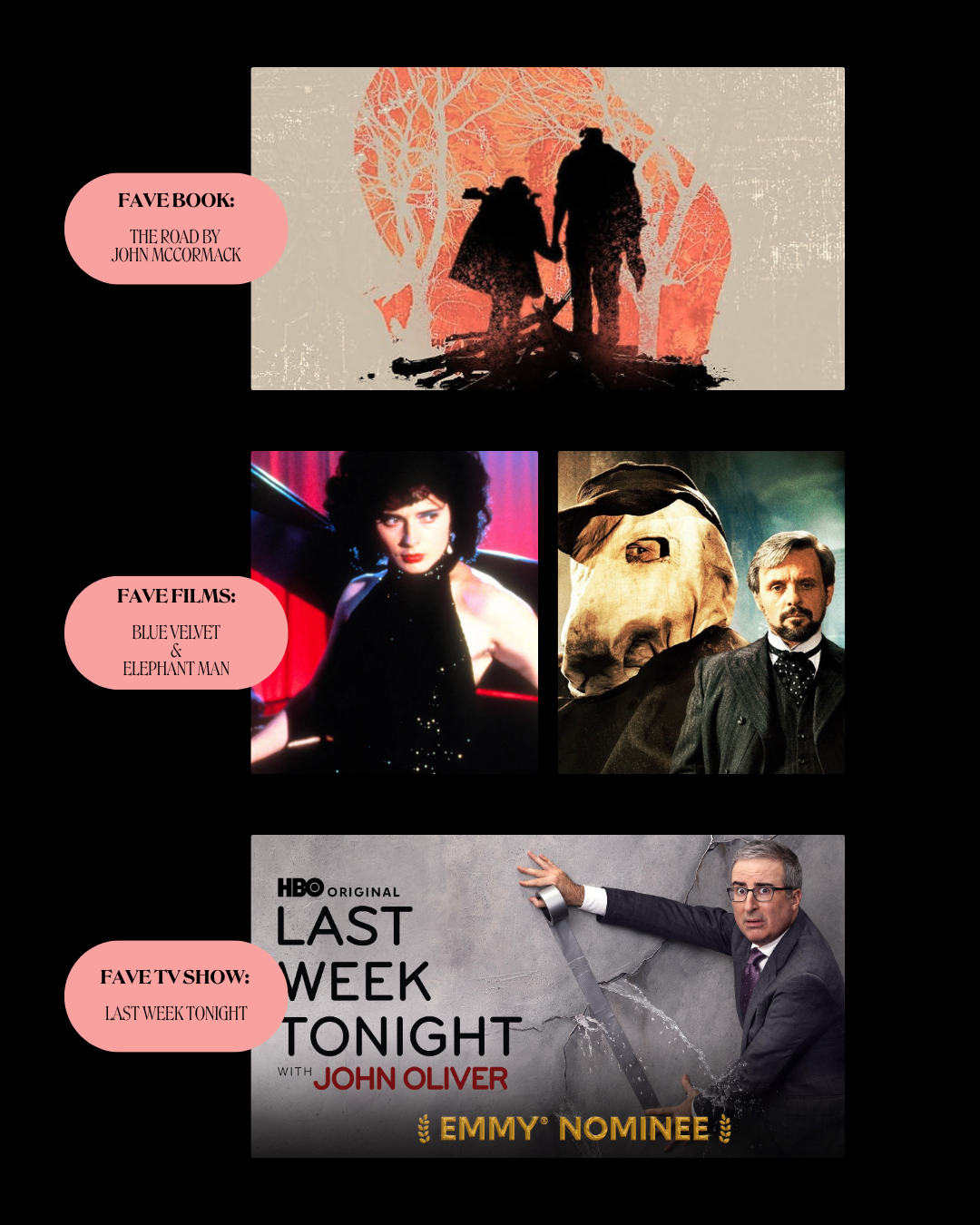
Roar: Tell us your favourite:
- The Road by Cormac McCarthy
- Blue Velvet and The Elephant Man by David Lynch
- Last Week Tonight - John Oliver or Daniel Sloss stand-up specials on Netflix
Roar: What do you listen to when you work?
At the moment, a lot of Dutch: podcasts, series, anything I can get my hands on. I’m trying to improve to the point where I can think directly in Dutch, and for that to work, Dutch needs to be the soundtrack of my days for some time
Roar: Share your favourite recipe (if you cook) or if you're not a cook, maybe your favourite takeout?
Parmigiana di melanzane. I make a mean one, and it's usually a three-day affair, every time I do, so I can fill the freezer with it (Pro tip: don't eat it right out of the oven. Let it sit overnight and heat it up the day after. Then it's when it reaches peak perfection)
Skye @ Roar: OMG this sounds uh-mazing, I'm (I’m cooking this soon!)
Roar: Country you would love to visit?
I would love to go back to Mexico. I have been itching to go back since the first time I was there.
Roar: Something you've been itching to draw but have not had an opportunity yet?
A (fiction) book cover. And if you're really taking requests, I would love to illustrate something by Cormac McCarthy or by Jorge Amado.
Roar: What is something you feel people should know earlier on in their career?
Too much love and enthusiasm for your work can actually hurt your career.
Let me explain: I am not the saddest illustrator in the history of image-making, I promise. Quite the opposite: when I started out, the only thing I could think was, “I love drawing. Whatever, as long as I get to draw for a living, I’ll be happy.”
Well… no. Trying to please everyone and fit every opportunity is not a winning strategy. It doesn’t make anyone happy, and it certainly didn’t make me successful. Plenty of people told me that early on: teachers, other (successful) illustrators… I ignored them all and went off to figure it out for myself. Eh. They were right.
Working on things you’re actually interested in leads to better work. Better work leads to a more coherent, more honest portfolio. And a clear portfolio makes it much easier for art directors to understand what to come to you for, initiating a “virtuous cycle,” otherwise called “nice projects running and money in the bank account.”
Roar: Such thoughtful and important words, thank you Chiara!
Roar: Favourite snack?
Gelato! Leave the kale smoothies for the hipsters downtown and give me something extra sugary. It's a snack, not a penance
Roar: Any last thoughts for the readers?
If you are a potential client: Hire me! I am great to work with
If you are a fellow illustrator: Ciao, thanks for making it this far, and feel free to reach out on social media
If you are a new graduate/ beginner illustrator: There are a thousand ways to build your career. All are valid. You'll find a lot of people with the truth up their sleeve, ready to tell you how to be successful. Take what you need, leave what you don't, and go figure it out by yourself. You'll be fine.
For everybody else: Ciao! Thank you for reading

"Self-doubt comes with the package, doesn't need to be a drama. It comes, it goes, and maybe -some time- even leaves behind some motivation to do better."
- Chiara Vercesi
Contact & Commission
Looking to commission a new illustration?
Interested in joining the team?
Or just want to say hello?